Mini Tools for Gaia data
Note
astroNN only contains a limited amount of necessary tools. For a more comprehensive python tool to deal with Gaia data, please refer to Jo Bovy’s gaia_tools
astroNN.gaia module provides a handful of tools to deal with astrometry and photometry.
The mission of the Gaia spacecraft is to create a dynamic, three-dimensional map of the Milky Way Galaxy by measuring
the distances, positions and proper motion of stars. To do this, the spacecraft employs two telescopes, an imaging
system, an instrument for measuring the brightness of stars, and a spectrograph. Launched in 2013, Gaia orbits the Sun
at Lagrange point L2, 1.5 million kilometres from Earth. By the end of its five-year mission, Gaia will have mapped well
over one billion stars—one percent of the Galactic stellar population.
ESA Gaia satellite: https://sci.esa.int/gaia/
fakemag (dummy scale)
fakemag is an astroNN dummy scale primarily used to preserve the gaussian standard error from Gaia. astroNN
always assume there is no error in apparent magnitude measurement.
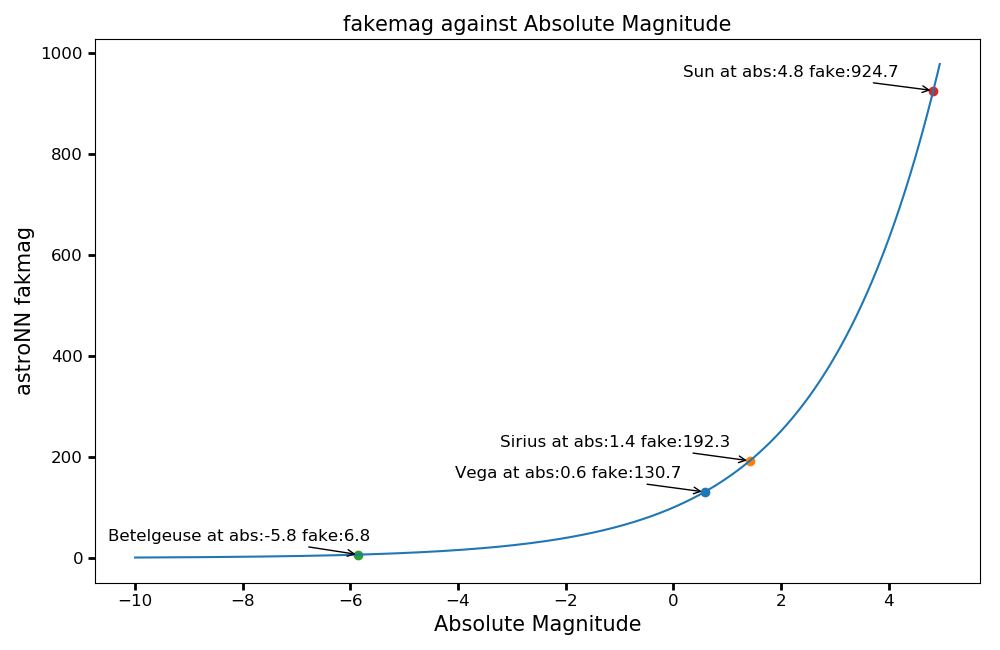
\(L_\mathrm{fakemag} = \varpi 10^{\frac{1}{5}m_\mathrm{apparent}} = 10^{\frac{1}{5}M_\mathrm{absolute}+2}\), where \(\varpi\) is parallax in mas
You can get a sense of the fakemag scale from the following plot
Coordinates Matching between catalogs xmatch
- astroNN.datasets.xmatch.xmatch(ra1, dec1, ra2, dec2, epoch1=2000.0, epoch2=2000.0, pmra2=None, pmdec2=None, maxdist=2)[source]
Cross-matching between arrays by RA/DEC coordiantes
- Parameters:
ra1 (ndarray) – 1d array for the first catalog RA
dec1 (ndarray) – 1d array for the first catalog DEC
ra2 (ndarray) – 1d array for the second catalog RA
dec2 (ndarray) – 1d array for the second catalog DEC
epoch1 (Union([float, ndarray])) – Epoch for the first catalog, can be float or 1d array
epoch1 – Epoch for the second catalog, can be float or 1d array
pmra2 (ndarray) – RA proper motion for second catalog, only effective if epoch1 not equals epoch2
pmdec2 (ndarray) – DEC proper motion for second catalog, only effective if epoch1 not equals epoch2
maxdist (float) – Maximium distance in arcsecond
- Returns:
numpy array of ra, dec, separation
- Return type:
ndarrays
- History:
- 2018-Jan-25 - Written - Henry Leung (University of Toronto)2021-Jan-29 - Updated - Henry Leung (University of Toronto)
Here is an example
>>> from astroNN.datasets import xmatch
>>> import numpy as np

>>> # Some coordinates for cat1, J2000.
>>> cat1_ra = np.array([36.,68.,105.,23.,96.,96.])
>>> cat1_dec = np.array([72.,56.,54.,55.,88.,88.])

>>> # Some coordinates for cat2, J2000.
>>> cat2_ra = np.array([23.,56.,222.,96.,245.,68.])
>>> cat2_dec = np.array([36.,68.,82.,88.,26.,56.])

>>> # Using maxdist=2 arcsecond separation threshold, because its default, so not shown here
>>> # Using epoch1=2000. and epoch2=2000., because its default, so not shown here
>>> # because both datasets are J2000., so no need to provide pmra and pmdec which represent proper motion
>>> idx_1, idx_2, sep = xmatch(ra1=cat1_ra, dec1=cat1_dec, ra2=cat2_ra, dec2=cat2_dec)
>>> idx_1
array([1, 4, 5])
>>> idx_2
array([5, 3, 3])
>>> cat1_ra[idx_1], cat2_ra[idx_2]
(array([68., 96., 96.]), array([68., 96., 96.]))

>>> # What happens if we swap cat_1 and cat_2
>>> idx_1, idx_2, sep = xmatch(ra1=cat2_ra, dec1=cat2_dec, ra2=cat1_ra, dec2=cat1_dec)
>>> idx_1
array([3, 5])
>>> idx_2
array([4, 1])
>>> cat1_ra[idx_2], cat2_ra[idx_1]
(array([96., 68.]), array([96., 68.]))